75 merged PRs in a day and a half, and why none of that was the slow part
Between lunchtime on 19 October and 01:43 on 21 October, cloud agents opened 79 pull requests on kiln. 75 of them merged. I didn't write a line of that code, and I didn't review most of it either.
That sounds like the good news. The catch is that it still took me most of 20 October to get one release onto my server, and the reason wasn't the code. This post is about what was slow and what I changed.
Much of this setup follows how poteto (Lauren Tan) works with agents. Most of the good ideas below started as one of her posts, and I've embedded the ones that changed my setup the most.
The setup
Kiln is a small runtime for Firecracker microVMs. You ask it for a "box", it boots one, and you get SSH, a dashboard, and a sign-in that goes through dark-forge.dev. It runs on a single bare-metal host.
I drive it from Grok Bot, a desktop assistant app where I can run several bots side by side. At first I just asked Grok Bot to kick off coding jobs directly. That worked, but my main chat filled up with build logs and PR links.
So I made Forge. Forge is an engineering lead that never writes code. It turns my asks into Cursor cloud agent jobs. Each agent runs in its own VM, does the work, and opens a PR. Forge then follows the PR through to merge and release.
Every brief Forge writes tells the agent to use pstack, poteto's skill pack. Its rules are short: make the smallest diff, fix the root cause, and prove it works.
The PR titles from 19 October show what that bought me. The agents moved the installer from Python to bash (#14), added a deploy to dark-forge.dev from GitHub Actions (#7), put the CLI behind identity sign-in (#19), and started serving the dashboard API (#25). The first PR opened at 12:58. By 02:23 the next morning, 27 had merged.
The bot team
One bot opening PRs is easy. The harder question was who checks them.
Around 19 October I added Proof, an independent reviewer. Proof read the diff, then drove each change like a user would, posted the evidence, and gave a PASS or FAIL verdict naming the exact commit SHA it tested. The group chat I'd called "Forge review" turned into the "Kiln" chat, where the bots talked to each other.
Then I added Kiln Ops, the deploy bot. It is the only bot that holds the deploy key for the dark-forge.dev host. Kiln Ops can only make outbound HTTPS calls, so it deploys through cloud agents as well. Every deploy pins Firecracker 1.17.0, runs kiln-runtime doctor (which has to report development_ready: true), boots a real box as a smoke test, and records a runbook PR.
I also adopted poteto's shipping rules:
- Merge only with a verdict at the PR's current head SHA.
- One PR at a time, bottom of a stack first.
- Read each PR back after it merges, to confirm it landed.
On 20 October I gave the bots a standing yes. Routine PRs, merges, releases and deploys no longer needed me. A short list still does: force-pushes, tags and branches, repo settings, secrets and keys, authorized_keys, and anything touching identity or login.
This is what the flow looked like that day:
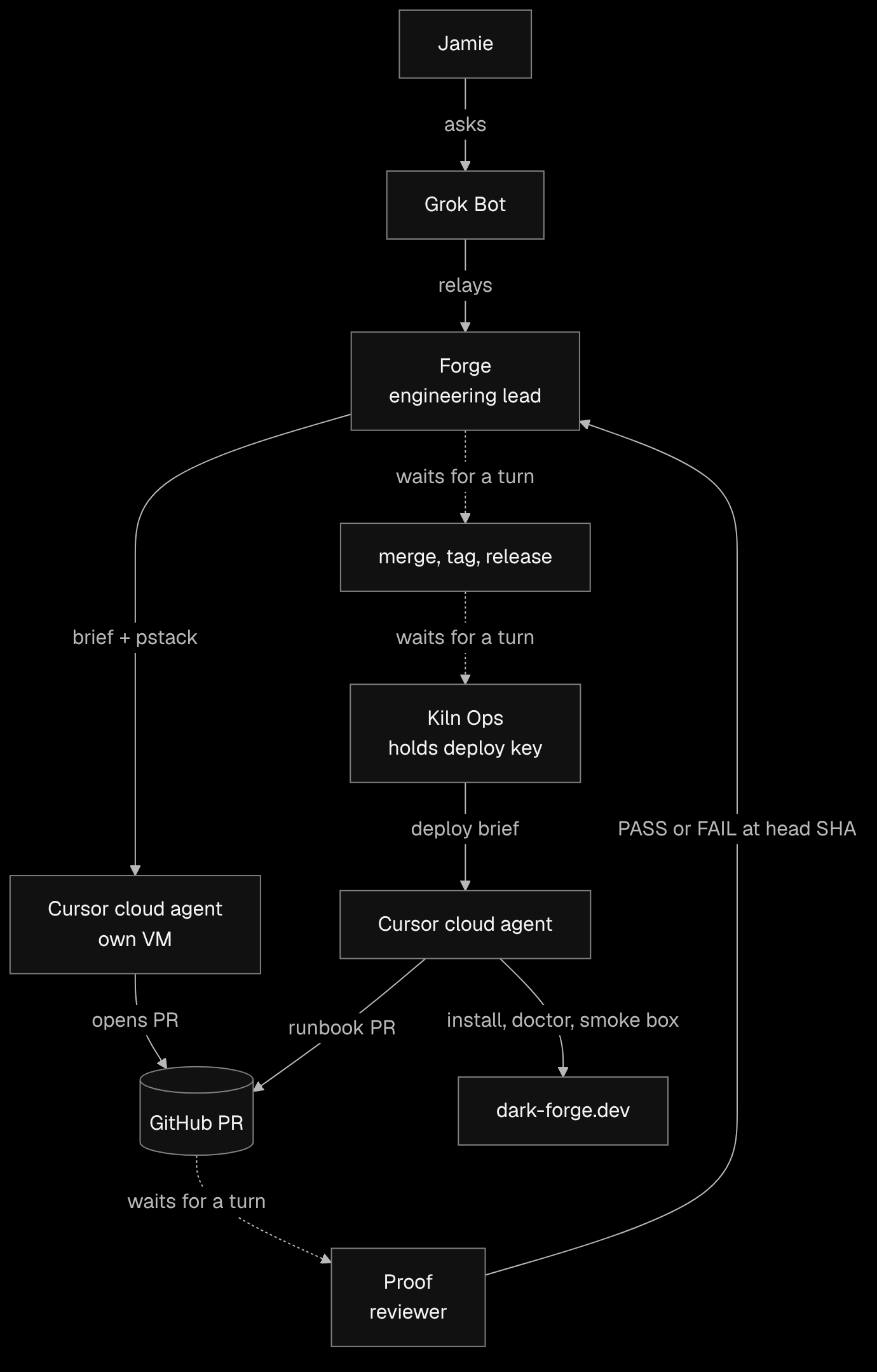
Diagram source
flowchart TD
  J[Jamie] -->|asks| G[Grok Bot]
  G -->|relays| F[Forge<br/>engineering lead]
  F -->|brief + pstack| CA[Cursor cloud agent<br/>own VM]
  CA -->|opens PR| PR[(GitHub PR)]
  PR -.->|waits for a turn| P[Proof<br/>reviewer]
  P -->|PASS or FAIL at head SHA| F
  F -.->|waits for a turn| M[merge, tag, release]
  M -.->|waits for a turn| K[Kiln Ops<br/>holds deploy key]
  K -->|deploy brief| CA2[Cursor cloud agent]
  CA2 -->|install, doctor, smoke box| H[dark-forge.dev]
  CA2 -->|runbook PR| PR
The bottleneck
On paper, 20 October was a huge day. 48 PRs merged between midnight and midnight. Most of it happened between 09:00 and midnight, and the busiest stretch ran from 15:00 to 18:00. Eight PRs opened in the 15:00 hour alone.
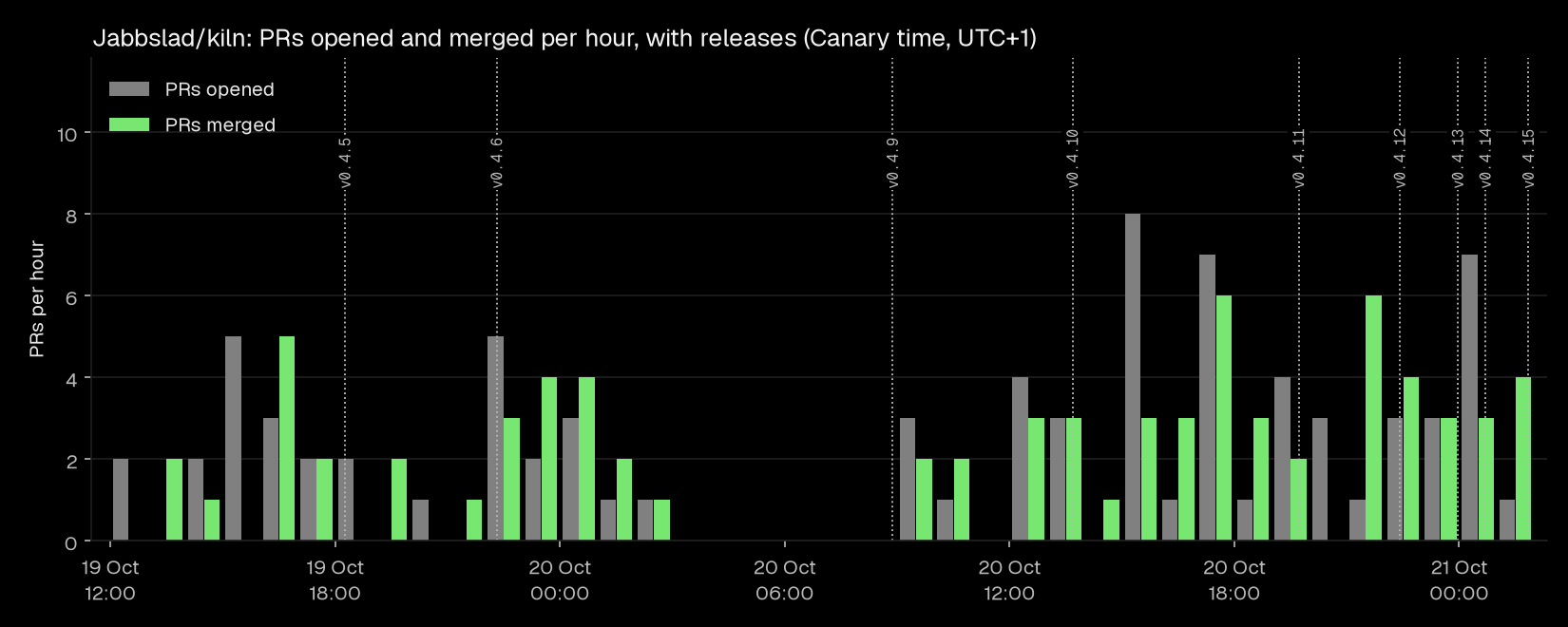
From inside it felt slow. In the afternoon I asked Grok Bot:
Why so few? Stuff has been happening all day but I'm struggling to understand why it's taken so long for anything to get deployed.
Grok Bot's answer was that each handoff was a bot waiting for another bot's turn. A review was requested, then a verdict came back, then someone merged, tagged, released, and deployed. None of those steps ran on their own. Each one waited for some bot to notice it was up. A review took about 15 minutes, and every FAIL meant another round trip.
My reply was "Even 15 mins isn't quick."
The numbers back that up. v0.4.11 was published at 19:43. It wasn't deployed and declared ready until about 22:10, after I tested kiln login from a machine that wasn't the host. That's close to two and a half hours from release to "it works", for a release that was already built and packaged.
The issue Grok Bot wrote that night says it plainly. On 20 October "six PRs merged ... and v0.4.11 shipped, but it took all day. Most of the delay wasn't review or CI." One PR, #66, "sat idle after rework because nobody re-requested review from Proof."
The fixes
I made the changes one at a time, in this order.
Faster reviews. Reviews had to be quick. Notes that didn't block a merge went into one cleanup PR at the end of the day, and FAIL was kept for real blockers.
Issue #68. Grok Bot opened "Make the PR-to-deploy handoffs deterministic". It proposed three things: re-request review on every push, auto-merge when the checks are green, and deploy when a v* tag is pushed.
Verdicts as a status. PR #71 posted Proof's verdict as a proof commit status. That gave the merge a machine-readable gate instead of a chat message.
A new rule. Any test or check step becomes code, either a script or a CI job, instead of something an agent runs by hand.
That last rule is where things really changed, and poteto had already written about it. Her team runs an agentic code review that rates every PR for risk, and the low and medium risk ones merge without a human review:
we have agentic code review, so every PR gets assessed for risk. low-medium risk ones don't require a review so you just merge it. also bugbot of course
lauren (@poteto) October 8, 2026
there's many more interesting ideas we have for the agentic forge that we've been discussing cc @jacobgold
The next day she put it more bluntly:
anything requiring a human review step is ngmi
lauren (@poteto) October 9, 2026
A week later she posted what she calls an inverse pyramid of trust. Most of the effort goes into the codebase itself (types, invariants, clear boundaries), then static analysis and tests, then prose like rules and skills, and the least into human review:
how do you trust your agents' work more? copy this post/link and give it to your @bot or agent!
lauren (@poteto) October 16, 2026
1. codebase improvements: this is just good software engineering - better architecture, stronger types and invariants, clear boundaries. agents love to copy what exists and take the shortest path, so make the easy thing the right thing. categorically eliminate problems through code and you won't need to think about it again.
2. static analysis: lint rules, tests, CI, verification (eg TLA+). very token efficient ways to catch issues ahead of time.
3. prose: comments, rules, AGENTS.md, skills - anything that can't be enforced and requires agent judgment. use it minimally, but do use /create-verification-skill.
4. human review: the hardest to scale. at the rate agents land code, it's pretty much impossible to thoroughly review every PR, so spend that effort on the highest leverage point, designing an environment where agents do the right thing by default.
this forms an inverse pyramid: you want most of your effort at the top, least at the bottom.
She also reviews the videos and screenshots her agents record rather than reading every diff.
Proof was a review step on every single PR, which is the part of that pyramid she spends the least on. So later that night I dropped Proof completely.
CI is the reviewer. A PR now merges when every CI check is green at its current head. The things Proof used to check by hand became coded checks. PR #74 added guards for attestation, secrets and tool downloads. PR #80 refuses a release tag that doesn't match the Cargo version. PRs that touch workflows, deploy, login or secrets get a risk flag from CI.
Deploy from a tag. PRs #72, #75, #76, #77 and #80 to #82 moved the deploy into the release build. Push a v* tag, and the build that publishes the release goes on to deploy it, then opens the installer re-pin PR.
Signed releases. v0.4.12, published at 22:25, was the first signed release. It carries GitHub build attestations that I can check with gh attestation verify. Kiln Ops deployed it with every signature verified and the smoke box passing.
Chief. I also set up Chief, a chief-of-staff bot. poteto talks mostly to her chief of staff, who talks to her engineering lead, and I copied that. I talk to Chief, Chief relays to Forge, and the engineering chatter stays out of my main chat.
Here's the pipeline now:
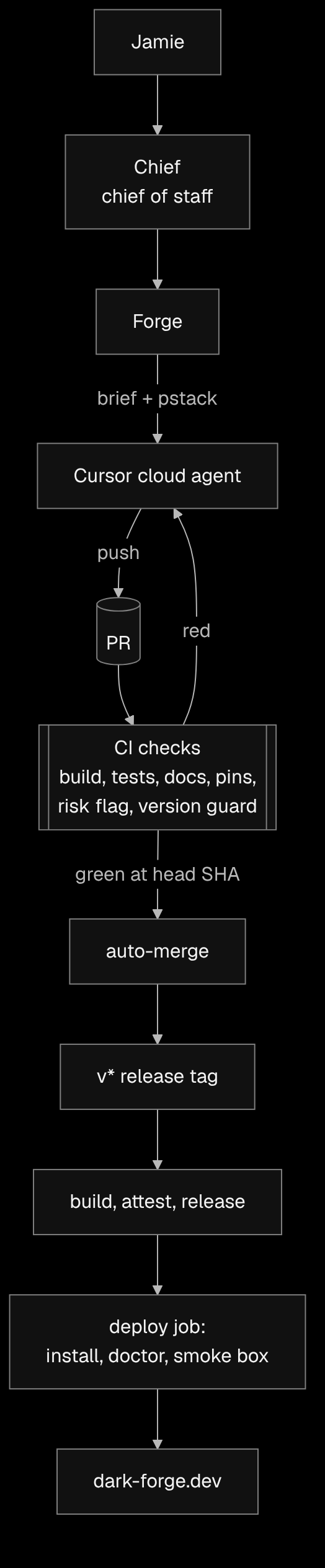
Diagram source
flowchart TD
  J[Jamie] --> C[Chief<br/>chief of staff]
  C --> F[Forge]
  F -->|brief + pstack| CA[Cursor cloud agent]
  CA -->|push| PR[(PR)]
  PR --> CI[[CI checks<br/>build, tests, docs, pins,<br/>risk flag, version guard]]
  CI -->|green at head SHA| AM[auto-merge]
  CI -->|red| CA
  AM --> T[v* release tag]
  T --> B[build, attest, release]
  B --> D[deploy job:<br/>install, doctor, smoke box]
  D --> H[dark-forge.dev]
The result
I split the merged PRs into three phases by when they were opened, and measured the time from open to merge.
| Phase | Merged PRs | Median | P90 |
|---|---|---|---|
| 19 Oct 12:58 to 20 Oct 02:23 (setup) | 27 | 23 min | 86 min |
| 20 Oct 09:00 to 22:57 (bot handoffs) | 38 | 20 min | 91 min |
| 20 Oct 23:00 onward (CI is the reviewer) | 10 | 10 min | 35 min |
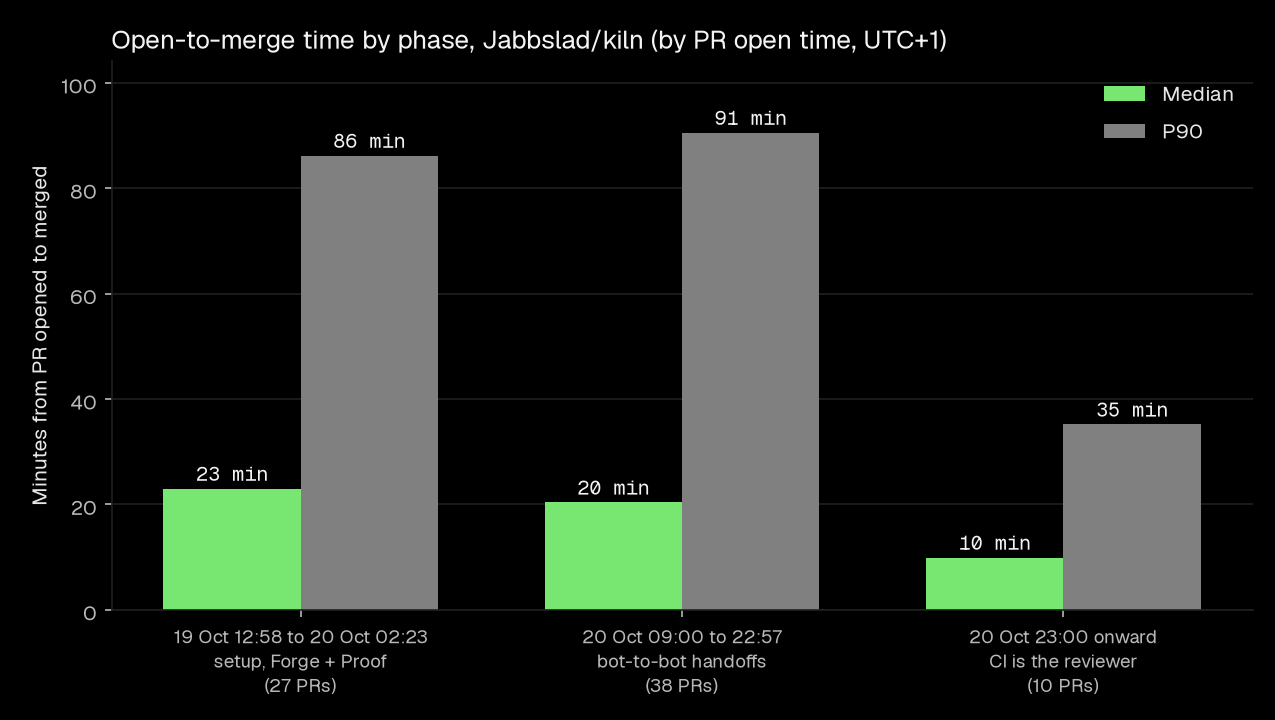
The last phase only has 10 PRs, so I don't want to oversell it. But the median halved and the P90 went from an hour and a half to about half an hour. Releases sped up too. v0.4.12, v0.4.13 and v0.4.14 were published at 22:25, 23:58 and 00:42. Each tag build took between 5 and 7 minutes.
Across the whole run, from v0.4.1 on the morning of 19 October to v0.4.15 at 01:51 on 21 October, kiln shipped 14 releases.
The deploy half isn't finished. The v0.4.14 tag build skipped its deploy job, and #81 fixed that path. The v0.4.15 build got all the way to the deploy job and then failed at the "Install the release" step. The plumbing is in place, but the first automatic deploy hasn't gone green yet.
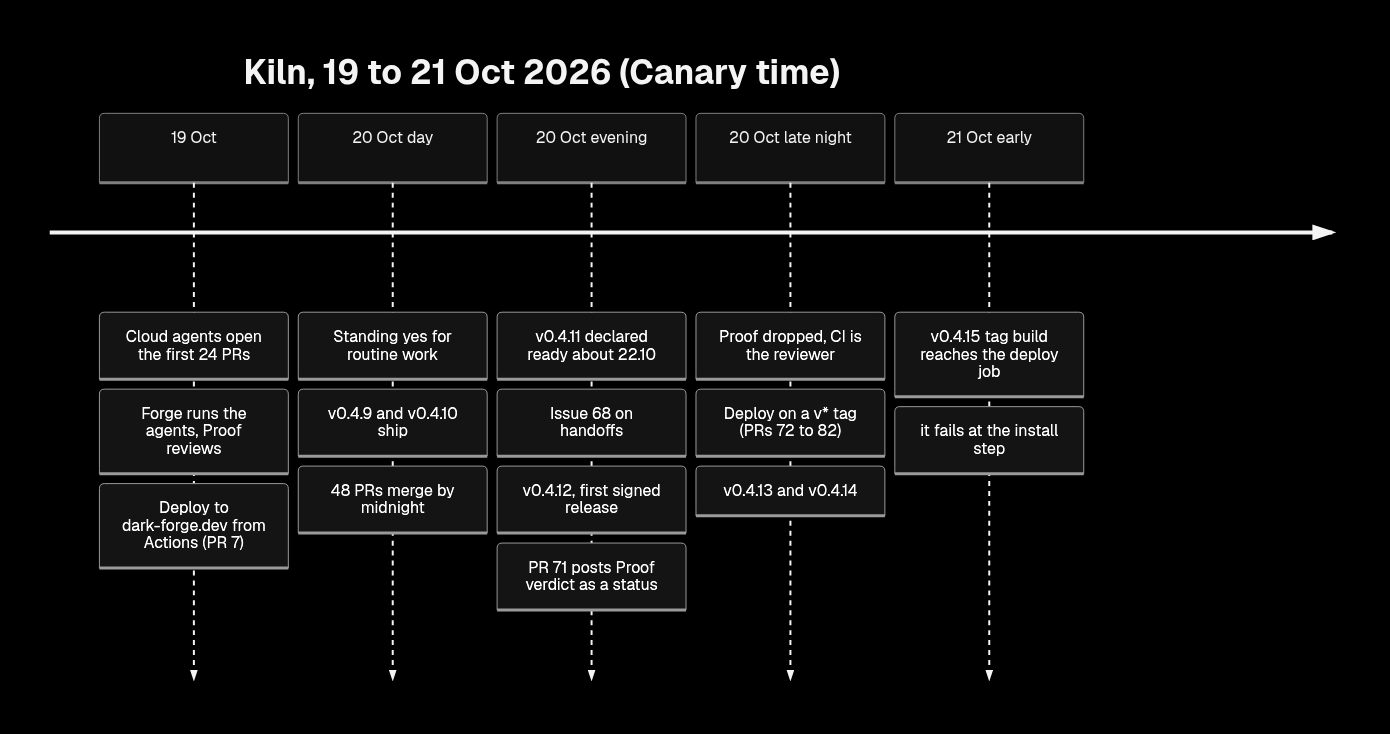
Diagram source
timeline
  title Kiln, 19 to 21 Oct 2026 (Canary time)
  19 Oct : Cloud agents open the first 24 PRs : Forge runs the agents, Proof reviews : Deploy to dark-forge.dev from Actions (PR 7)
  20 Oct day : Standing yes for routine work : v0.4.9 and v0.4.10 ship : 48 PRs merge by midnight
  20 Oct evening : v0.4.11 declared ready about 22.10 : Issue 68 on handoffs : v0.4.12, first signed release : PR 71 posts Proof verdict as a status
  20 Oct late night : Proof dropped, CI is the reviewer : Deploy on a v* tag (PRs 72 to 82) : v0.4.13 and v0.4.14
  21 Oct early : v0.4.15 tag build reaches the deploy job : it fails at the install step
What I learned
Agents writing code was never the slow part. On my busiest day the agents opened 47 PRs, and the median one merged 18 minutes after it opened. The slow part was everything between "merged" and "running on the server": a bot waiting for another bot, a review that had to be asked for again, a deploy that started when someone noticed it was time.
Every one of those waits was a check that lived in a bot's head. Proof knew how to drive a change like a user. Kiln Ops knew to run doctor and boot a smoke box. Forge knew to re-request review after a push. When that knowledge sits in a bot, it runs whenever the bot gets around to it. In CI it runs on every push.
So my rule now is simple. If a bot checks something by hand, that check should be a CI job.
What's next
- Get the tag-triggered deploy green. The v0.4.15 run tells me exactly which step to fix.
- Finish #78, which replaces the Python CI checks with
cargo xtask, so the checks live in the same language as the code they check. - Keep moving checks down the pyramid. Every time I catch myself asking a bot "did you test X?", that's a missing CI job.
I'll write a follow-up once a tag goes from push to a passing smoke box with nobody touching it.
Thanks to poteto for writing so openly about how she works with agents. This setup would look very different without her posts.